




 |
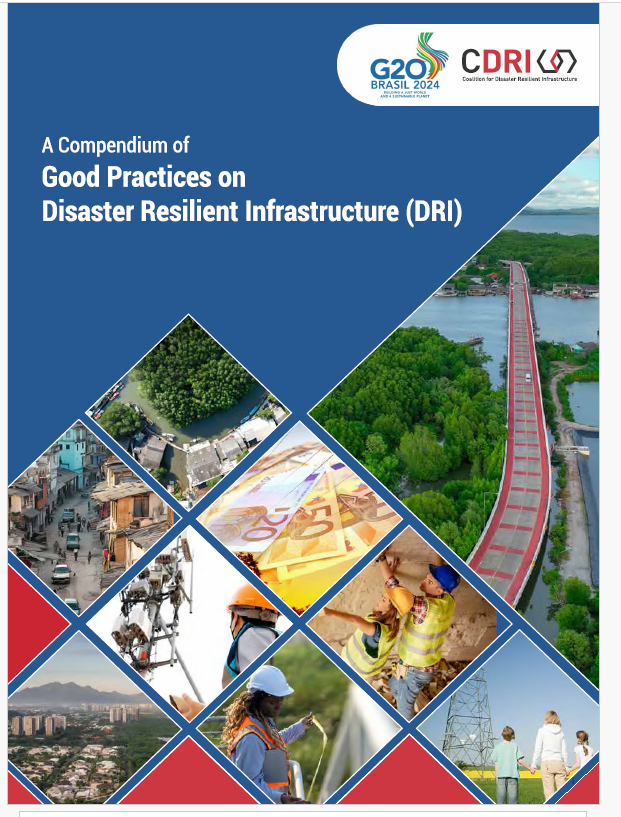
This compendium, titled "A Compendium of Good Practices on Disaster Resilient Infrastructure (DRI)," is a collaborative publication curated under Brazil's G20 Presidency in partnership with the Coalition for Disaster Resilient Infrastructure (CDRI) and contributions from G20 members, invited countries, and organizations. Published in 2024, it compiles 52 case studies showcasing innovative strategies to enhance infrastructure resilience against disasters, emphasizing equity, social justice, and sustainable development. Organized into seven themes, the document covers sector-specific interventions (e.g., early warning systems in India's hydropower, floating solar plants in Mexico); post-disaster reconstruction (e.g., cyclone recovery in Tonga); financing mechanisms (e.g., Australia's Disaster Ready Fund); nature-based solutions (e.g., green infrastructure in Madagascar); risk assessments and stress testing (e.g., global models like GIRI); governance strengthening (e.g., seismic codes in Portugal); and infrastructure's role in social-economic resilience (e.g., water integration in Brazil). It highlights scalable practices to reduce vulnerabilities in Least Developed Countries, Landlocked Developing Countries, and Small Island Developing States, integrating lessons from hazards like floods, earthquakes, and cyclones. A DRI Lexicon provides standardized terminology. This resource aids policymakers, engineers, and stakeholders in fostering proactive, inclusive approaches to minimize losses, promote adaptation, and align with global frameworks like the Sendai Framework and SDGs. |
