
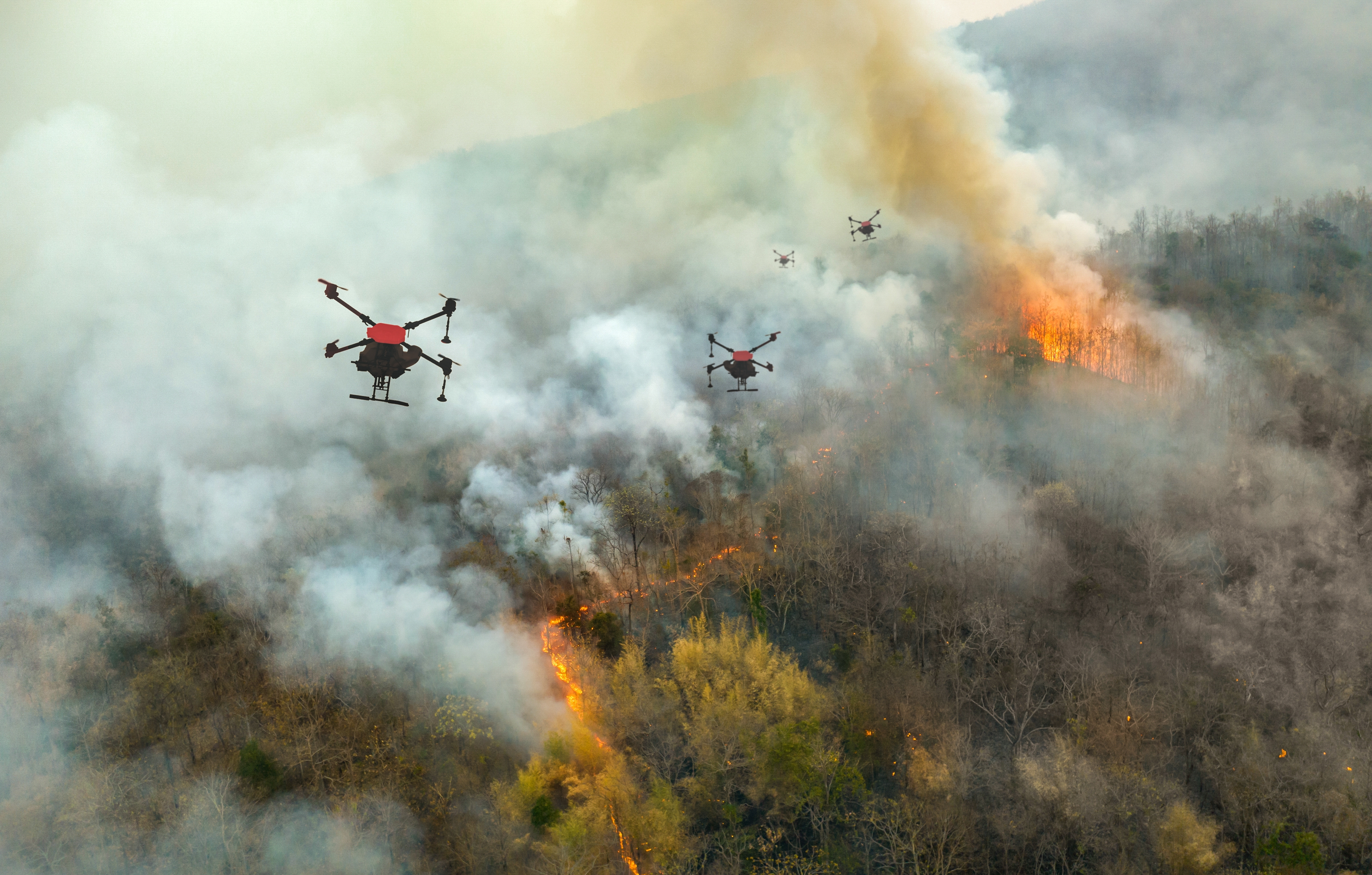
Drones help fight wildfires, Source: Shutterstock |
Over the past decade, 80 percent of Japanese prefectures and many major cities in Japan have adopted the use of drones for post-disaster damage surveys, greatly speeding up assessments and ensuring resources are directed strategically. Low-earth orbit satellite constellations such as Starlink, which function independently of terrestrial communication networks, are proving critical for restoring internet connectivity (which is vital for data collection and early warning systems) in affected areas after disasters, such as during the 2022 Tonga volcanic eruption. Elsewhere, Habitat for Humanity in the US and 14Trees in Malawi have piloted large-scale 3D printing to accelerate post-disaster reconstruction, using robotic arms to build houses in less than 30 hours at up to 20 percent lower costs than traditional methods. |
|
"Technology for resilience pays. Technology investments are generally a small part of the overall cost of infrastructure projects, and also a small fraction of the economic costs of service interruptions." |
|
|
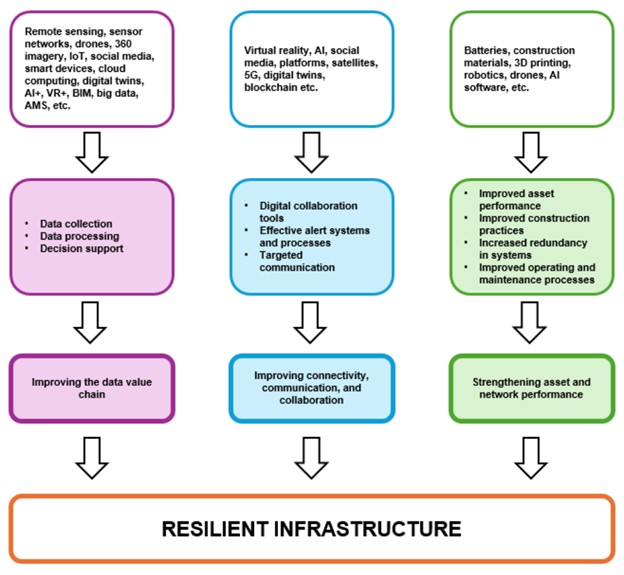
A recent Deloitte study suggests that AI-powered solutions for hazard mitigation and vulnerability reduction could save approximately $70 billion annually in direct disaster costs for infrastructure by 2015 – equivalent to 15 percent of estimated average losses. Over the past decade, 80 percent of Japanese prefectures and many major cities in Japan have adopted the use of drones for post-disaster damage surveys, greatly speeding up assessments and ensuring resources are directed strategically. Low-earth orbit satellite constellations such as Starlink, which function independently of terrestrial communication networks, are proving critical for restoring internet connectivity (which is vital for data collection and early warning systems) in affected areas after disasters, such as during the 2022 Tonga volcanic eruption. Elsewhere, Habitat for Humanity in the US and 14Trees in Malawi have piloted large-scale 3D printing to accelerate post-disaster reconstruction, using robotic arms to build houses in less than 30 hours at up to 20 percent lower costs than traditional methods. And a recent Deloitte study suggests that AI-powered solutions for hazard mitigation and vulnerability reduction could save approximately $70 billion annually in direct disaster costs for infrastructure by 2015 – equivalent to 15 percent of estimated average losses. These are just a few examples of revolutionary changes in technology that are changing how infrastructure – itself a product of the application of technology to address human needs – is being rewired to respond and recover better from climatic and geological disasters. Technology offers practical solutions throughout the infrastructure and disaster lifecycles to enhance resilience across complex, interconnected infrastructure assets and networks. It also brings attractive financial benefits by reducing lifecycle costs, improving service continuity, and lowering insurance premiums. For developing countries, where disasters are frequent, resources are constrained, and infrastructure deficits remain significant, investing in technology-enabled recovery systems is a strategic priority. Many tools and technological platforms are increasingly modular, scalable, and affordable, making them adaptable across different contexts. CDRI’s second Global Infrastructure Resilience (GIR 2025) report explores how technologies can be harnessed to strengthen infrastructure resilience. It presents an action-oriented, objectives-based framework designed to support and guide infrastructure decision-makers in identifying and deploying the most relevant technologies to enhance resilience. More than 35 different types of technologies for resilience were reviewed across more than 100 case studies and applications from all over the world. As shown in Figure 1, these technologies can be organized around three core objectives for increasing resilience:
|
|
|
"The benefits of technology can be short-lived for want of the right enabling environment. The challenge ahead lies not in installing new technologies, but in deploying them wisely, equitably, and with a view to long-term transformation of resilient infrastructure services." |
|
|
Figure 1. Framework to connect technology with resilient infrastructure outcomes |
|
|
Taken together, these three objectives provide a comprehensive framework to understand how technologies can help increase the resilience of infrastructure. They illustrate that resilience is not achieved through isolated innovations but through a coordinated approach where better data, stronger communication, and more durable assets reinforce each other. The chapter offers several case studies from across the world of how technology can be used to enhance the three capacities for resilience (absorb, respond, recover) identified by GIR 2025 as being essential to building resilience. The Capacity to Absorb Novel construction materials, such as carbon-sequestering concrete, self-healing polymers, and recycled composites, are improving the durability and sustainability of infrastructure. 3D printing and modular construction methods allow for faster, more precise building practices, reducing vulnerabilities while often lowering costs. Another critical enabler to increasing the capacity to absorb shocks is improved access to hazard, vulnerability and exposure data, which can be fed into improved communications networks. For example, SEEDS in India has piloted an AI-powered system that tailors cyclone warnings to individual households, using data on dwelling type, location, and hazard exposure. This approach was deployed ahead of Cyclone Yaas in 2021. Water utilities equipped with Supervisory Control and Data Acquisition controls can reroute flows when pipelines are under strain, while intelligent transport systems can redirect traffic away from vulnerable routes during severe weather. The Capacity to Respond Immediately after a disaster, governments and infrastructure ministries, owners, and operators face enormous pressure to respond. Technology can be used to embed the capacity to respond into infrastructure systems even before a disaster occurs. Smart grids can automatically isolate damaged sections to contain outages, and automated shut-offs can reduce risks from failing assets. Post-disaster, modular bridges, mobile power units, prefabricated clinics, and portable water treatment plants can be pre-positioned and deployed rapidly, while diagnostic tools such as sensors and mobile testing labs help engineers make quick, evidence-based decisions on whether assets can be used, repaired, or replaced. The Capacity to Recover Last, technology is also vital to the capacity to recover. By combining pre- and post-disaster datasets with advanced modelling, governments can better understand how assets performed during the event, identify failures, and design reconstruction strategies informed by lessons learned. Shared digital platforms that consolidate infrastructure data, track funding flows, and map project progress are improving inter-agency cooperation and accountability, which are key to reconstruction efforts. Financial management technologies, including e-procurement platforms and blockchain-based systems, can enhance the transparency of fund allocation and reduce the risk of mismanagement. Such a blockchain-based cash transfer system has been used, for instance, by the Government of Vanuatu to support housing reconstruction after major cyclones. Importantly, technology does not always have to be highly advanced to be effective. Depending on objectives, context, resources, and institutional capacity, both high-tech, advanced solutions (e.g. sensors embedded in bridges, power lines, or water systems providing real-time data on asset conditions) and low-tech, simpler approaches (e.g. colour-coded poles along riverbanks, allowing communities to visually monitor rising water levels and trigger early action) can strengthen infrastructure resilience in different ways and can be mutually reinforcing. Nor is technology a silver bullet for building resilience. The benefits of technology can be short-lived for want of the right enabling environment. To unlock its transformative potential for resilient infrastructure requires coordinated governance, innovative financing, investment in data and skills, inclusive approaches, and sustained institutional leadership. Success depends on multiple stakeholders, including government, private innovators, civil society, international partners, implementers, and end users. |
|
|
by: Dr. Harriette Stone, Lead Author – Technology Component, GIR 2025 Report This blog forms part of a series under the ambit of CDRI’s second Global Infrastructure Resilience Report (GIR 2025). It is aligned with the Technology component of the GIR 2025 report. The main report, executive summary, and the corresponding working paper associated with this workstream are also available on CDRI's official website, at: https://cdri.world/resilience-dividend/global-infrastructure-resiliencereport-second-edition/. |
|