




 |
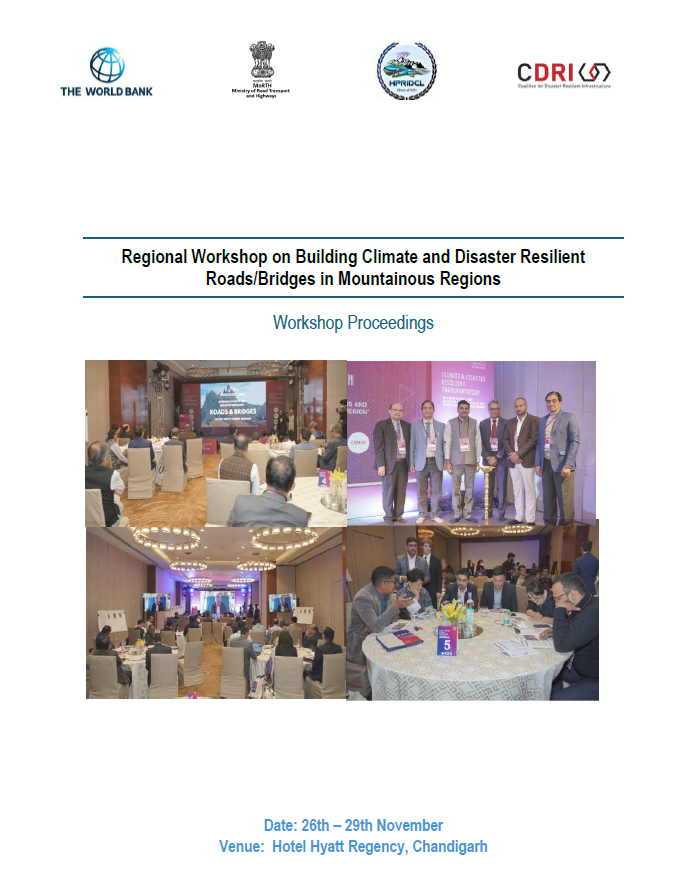
The Regional Workshop on Building Climate and Disaster Resilient Roads/Bridges in Mountainous Regions was held from November 26th to 29th, 2025, in Chandigarh, India. Organized by the World Bank and the Coalition for Disaster Resilient Infrastructure (CDRI), with support from MoRTH and HPRIDCL, the event convened over 60 participants from seven countries: India, Bhutan, Mongolia, Nepal, Papua New Guinea, Sri Lanka, and Vietnam. The workshop addressed the critical vulnerabilities of mountain infrastructure which cover 27% of the Earth’s land surface against escalating climate-induced hazards like landslides, floods, and glacial lake outbursts. It served as a regional platform to move from reactive maintenance to proactive resilience planning by fostering knowledge exchange and regional collaboration. The technical sessions were anchored in the World Bank’s "Five Pillars of Resilience": Network Planning, Design and Engineering, Operations and Maintenance (O&M), Contingency Planning, and Institutional/Financial Capacity. Discussions highlighted that creating a resilient ecosystem could globally generate 150 million jobs, while inaction risks losing 230 million. Key technical shifts proposed included transitioning from static mapping to dynamic multi-hazard risk assessments and adopting hybrid "green grey" solutions, such as bioengineering, to balance structural integrity with ecology. Experts emphasized that infrastructure should be designed to be "fail-safe," ensuring that even if assets fail during extreme events, they do so without catastrophic consequences. |
