
 |
The Sula Valley is one of the most productive regions in Honduras, its rivers and fertile soil drive much of the country's agriculture and industry. Yet, these same rivers and low-lying plains make it one of the country’s most flood-prone areas. Every hurricane season brings the risk of overflowing rivers, and in towns like Pimienta, Potrerillos and Villanueva, that risk frequently becomes a reality, with entire neighbourhoods, and the essential facilities that serve them, submerged. For the people whose homes, jobs, and communities are rooted here, relocation was never a realistic solution. The challenge, rather, is to ensure that the infrastructure people depend on every day, such as primary health facilities, is designed and built to withstand the floods that have become a reality. |
|
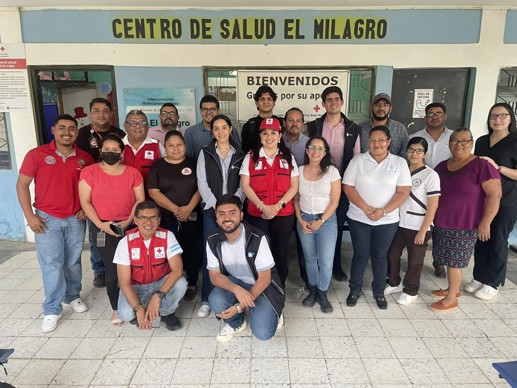
Honduran Red Cross team, Build Change Team, Villanueva, Pimienta and Potrerillos municipalities team in the Salud el Milagro Health Facility in Villanueva. |
|
|
A primary health facility is often a person’s first and sometimes the only point of contact with the healthcare system providing vaccinations, prenatal visits, and basic treatment. When that facility floods, loses its roof, or becomes inoperable, the consequences are immediate and tangible. It's the missed vaccination, the delayed prenatal visit, the interruption of lifesaving care, and the costly replacement of damaged equipment that could have been protected. |
|
|
|
|
|
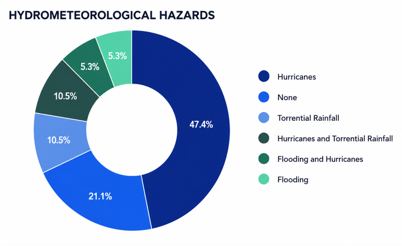
This chart shows the percentage of healthcare facilities that have been affected by each of these natural hazards. Source: Build Change on field assessments. |
|
|
Many of these facilities in Potrerillos, Pimienta, and Villanueva already exhibit signs of repeated climate impacts: humidity and flooding damage, roofs weakened by wind, and layouts that no longer support the care they are expected to provide. These buildings have endured floods, hurricanes, and extreme heat, and that history is exactly what shapes the structural questions now: what would it take to keep these facilities standing, operational and able to deliver the next time these hazards come around. |
|
 |
That's the expertise Build Change brings to this work: not just identifying that a roof is damaged but evaluating how the building performs against specific hazards and translating those into design decisions. Combined with the long-standing trust of the Honduran Red Cross, as well as guidelines from SESAL (Honduras's Ministry of Health), the Pan American Health Organization, and a resilience-planning lens from the CD-RISC framework, Build Change is providing evaluations that consider structural vulnerability and functional design. The resulting disaster readiness and vulnerability assessments provide COPECO (Permanent Contingency Commission) with a pre-crisis map of functioning health facilities when vulnerabilities are greatest and which populations are most at risk, ensuring fast, better coordinated emergency response when every second counts. |
|
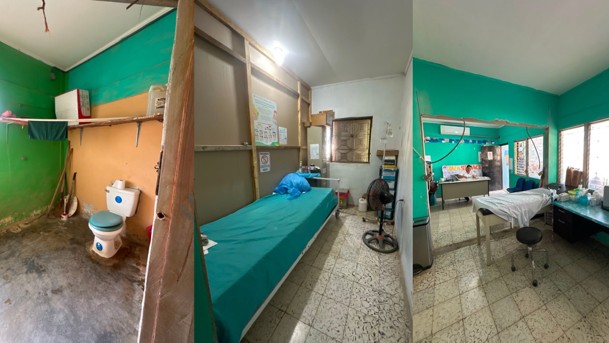
Villanueva Health Facility. Bathroom with moisture issues, no connection to potable water, and lacking the necessary finishes. Wooden partition walls that compromise the sanitation of the consultation room and provide limited fire resistance. Exposed electrical wiring. |
|
|
The goal is operational continuity: ensuring health facilities can not only continue delivering care but also resume quickly after a disaster. Rather than rebuilding after every flood or hurricane, targeted upgrades can protect critical functions and reduce recovery time. In many single-story centers, for example, adding a second floor creates a secure space for medical equipment and supplies than regularly having to replace it (whenever a disaster strikes). For heat, the approach is architectural rather than mechanical wherever possible: designing waiting areas with cross-ventilation to improve patient comfort without relying entirely on electricity and keeping medication storage windowless to protect supplies from contamination. Every facility has different vulnerabilities, different services, and different priorities—and the design must respond accordingly. Good retrofit designs solve today's problem. The harder, more valuable question is what Good retrofit designs solve today's problem. The more consequential question is what happens after this specific project ends, and that's where the second part of Build Change’s work comes in. Build Change's aim is not only to hand over ten completed retrofit designs across three municipalities, but to use this process as an anchor for institutional and community-wide awareness raising and capacity building. This means producing investment-ready retrofit designs, practical technical guidance, and a digital technical assistance platform that local governments can use independently. In a decentralized country where local governments are responsible for the local infrastructure, lasting resilience depends on more than stronger buildings, and that continuity is the difference between a one-time fix and a lasting local capability. |
|
|
Karen Cruz, Director of the Municipal Emergency Committee, Villanueva, has been a part of the data collection process alongside the Honduran Red Cross, shares her thoughts on why all of this matters and clearly captures the point: |
|
|
"I got my own vaccine at a health facility. My mother, my siblings, all of us got our vaccines at a health facility. Community health facilities are a foundation, they're part of us, they're part of the community. When people arrive at a health facility in excellent condition, with better care, that means a lot to the population. You can see it in how communities respond: health committees, emergency committees, neighborhood association presidents show up and work alongside the administrative and operational staff, organizing cleanup campaigns, even painting the building." |
|
| She also emphasized what Build Change’s digital tools and retrofit designs make possible: with time and resources sufficient to support only a limited number of facilities, the real value lies in methodologies and applications that municipalities can apply on their own and that can be replicated across more health facilities across territories, not just the ones in this first phase. | |
|
That is the project's lasting purpose: the retrofit designs, technical guidance, and digital platform are not the end products, they can be used as an anchor for capacity building and awareness raising at the community, local, and national level. The outcome is network of communities and institutions better equipped before the next flood, hurricane, or heat wave arrives. |
|
|
By: Ariana Karamallis, Director of Global Engagement, Build Change; Camila Ordonez, Global Communications Officer, Build Change |
|
|
Build Change extends its gratitude to the Government of India for their financial support through the Coalition for Disaster Resilient Infrastructure's Infrastructure Resilience Accelerator Fund (CDRI IRAF), and to the Honduran Red Cross and the municipalities of Potrerillos, Pimienta, and Villanueva. |
|