
 |
The macroeconomic impacts of disasters – for example, the long-term impacts of disrupted learning in schools; the failure of farmers to bring perishable produce to markets; or a drop in the value of financial assets, currencies, and commodities because of infrastructure disruptions, or even the perception of repeated disruptions – often exceed the direct losses suffered by infrastructure assets. In 2011, severe floods in Thailand not only caused a decline of 1.1 percentage points in real GDP growth compared to pre-shock projections but also reduced total household expenditures by 5.7 to 14 percent. Again, Puerto Rico’s slow recovery from Hurricane Maria in 2017 led not only to direct damages of $139 billion, but to 77 percent of small firms reporting direct losses, and the permanent closing of between 8,000 and 10,000 small businesses. |
|
Modelling the macroeconomic impacts of disasters accurately, then, can provide substantive answers to key questions about resilience, such as:
Through the use of integrated modelling approaches, the Global Infrastructure Resilience report 2025 tries to quantify the broader economic impact of insufficient infrastructure resilience. The analyses were conducted on eight countries – Bangladesh, Barbados, Bhutan, Fiji, Ghana, Kenya, Madagascar, and the Philippines – chosen to provide a geographically balanced and comprehensive perspective across Asia, Africa and Small Island Developing States (SIDS). The study makes use of the Green Economy Model (GEM), a comprehensive, country-level systems-based model (Figure 1) designed to assess the wide-ranging impacts of climate change. GEM has been applied to more than 50 countries in a customized form, and in the GIR 2025 report it is calibrated with CDRI’s Global Infrastructure Risk Model and Resilience Index (GIRI). |
|
|
The wider impacts of disasters on the economy are much larger and more long-lasting than direct infrastructure damages |
|
|
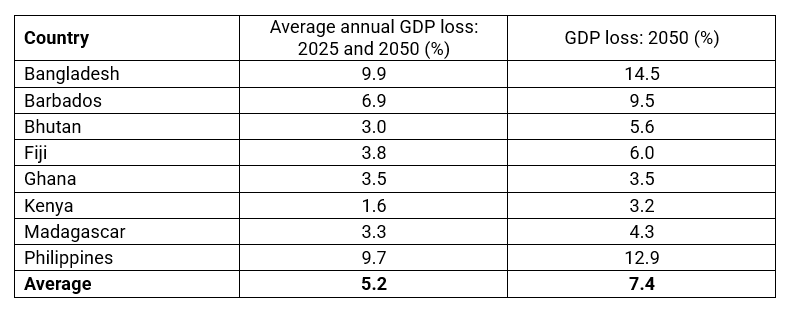
First, the combined model is used to estimate the impact on the economy caused by infrastructure damages by disasters. The average annual GDP loss over the next 25 years ranges from 1.6% (Kenya) to 9.7% (Philippines) and 9.9% (Bangladesh), with an average of 5.2%. As climate change will cause some disasters to become more frequent and intense, then the GDP loss in 2050 will increase, as shown in Table 1, where the average for the eight countries analyzed increases to 7.4%. |
|
|
|
|
|
Table 1: Economic Impacts of Infrastructure Failures due to Disasters |
|
|
These economic losses are much larger than the direct costs of infrastructure damaged by disasters. A ministry of roads is generally focused on the loss and damage to the roads it is responsible for. An airport operator cares about the direct damages to its infrastructure. However, a head of state, the Ministry of Finance, or the Ministry of Economy should also care about the wider impacts on the economy. Second, according to the modelling done for the GIR 2025, the impacts on the economy (measured as GDP loss) are, on average, more than seven times larger than the direct costs of the infrastructure damages. The ratio varies by country, and it can be as high as 16 times in Ghana or 11 times in Barbados. |
|
|
Building infrastructure resilience is not just a protective measure; it is an economic development strategy in itself. |
|
|
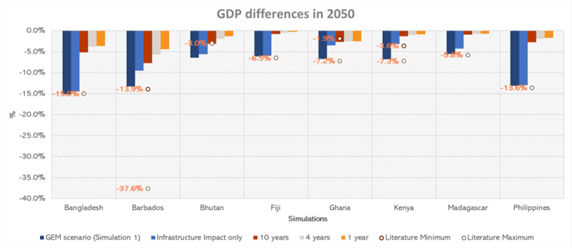
Third, the combined model was used to analyse the economic benefits of faster reconstruction programs after disasters. Typically, the reconstruction of assets is marked by limited funding, slow progress, and an incomplete recovery – a process that can last a decade or more. The model was used to compare the benefits of moving away from the typical slow and partial reconstruction to a full and faster recovery program. What would happen to the economy if the reconstruction were done fully in ten years? Or even faster in four years or one year, like it is common for many disasters in Japan? Figure 1 shows the results of this analysis for the eight countries analysed.
|
|
|
Figure 1. GDP impacts under different scenarios, compared to the range identified by the literature |
|
|
While the exact reduction varies by country, the overall trend is consistent: investing in full reconstruction over a decade, instead of a long and partial reconstruction process, reduces GDP losses by roughly half or more. Reducing the recovery period further to 4 years results in greater benefits, as the average GDP loss goes down to 2.27 percent. To conclude, these findings that the impacts on the economy are much larger than the direct damages to infrastructure caused by disasters. At the same time, faster and complete reconstruction programs can reduce that economic impact significantly. Resilience is, therefore, not merely an operational or engineering concern but a core economic strategy, generating economic co-benefits in the short-term and a ‘resilience dividend’ over time. Mobilizing resources today to strengthen infrastructure resilience, through both traditional and nature-based approaches, can safeguard growth, stabilize public finances, and ensure that economies remain robust in the face of climate and geological risks. |
|
|
By: Andrea Bassi (Founder and CEO, Knowledge Srl); Edvin Andreasson (Junior Project Manager, KnowlEdge Srl) |
|
|
This blog forms part of a series under the ambit of CDRI’s second Global Infrastructure Resilience Report (GIR 2025). The main report, executive summary, and the corresponding working paper associated with this workstream are also available on CDRI's official website, at: https://cdri.world/resilience-dividend/global-infrastructure-resiliencereport-second-edition/. |
|