

|
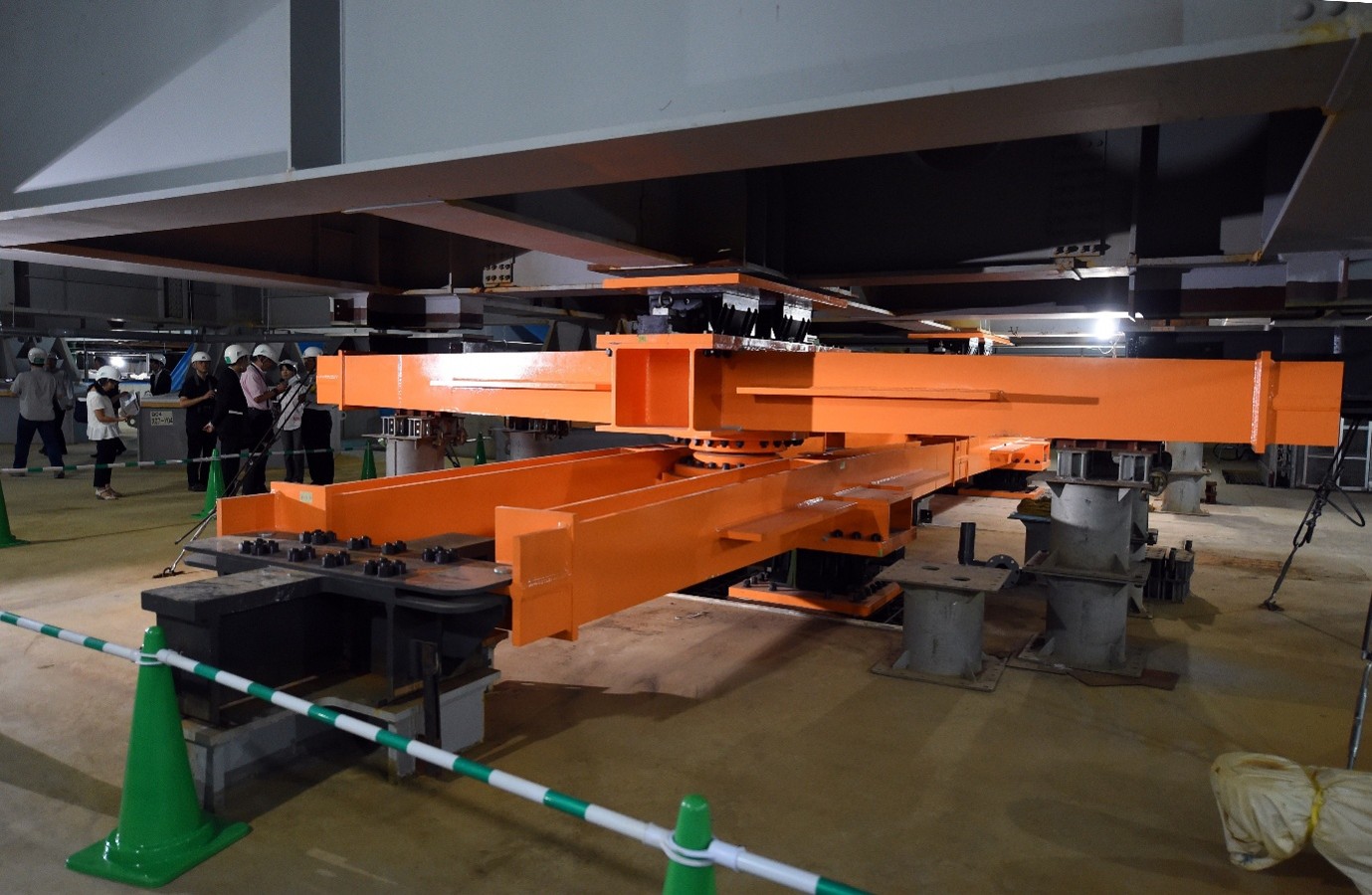
Japan, elasticity system for building |
The world is experiencing more frequent and intense disaster events that damage infrastructure, choke logistics, and disrupt labour and markets. How are businesses, which constitute the lifeblood of the economy, responding to such disruptions? The Global Business Resilience Survey (GBRS) commissioned for the GIR 2025 report provides, for the first time, a consolidated view of this matter. The survey gathered inputs from over 500 respondents across more than 50 countries, categorized into three groups:
|
|
For private sector companies, the case for investing in adaptation and resilience to protect their own businesses is compelling: some self-report benefit-to-cost ratios as high as 35:1. Large-scale surveys like GBRS help identify knowledge and capacity gaps in the business lifecycle, while circulating examples of good practice both within businesses and across the public and private sectors. The survey casts light on three key issues:
A total of 50 countries were selected across different exposure levels while maintaining geographic diversity. An online questionnaire reached more than 2,000 targeted contacts—primarily Chief Sustainability Officers, CEOs, and other high-level executives—and returned 506 validated responses. Questions covered both pre-event readiness (e.g., risk assessment, budgeting, SOPs) and post-event performance (e.g., time-to-recovery, bottlenecks, reliance on external support). |
|
|
Resilience building in business requires a value-chain perspective. Vulnerability is determined not only by a company’s own sites but by the resilience of suppliers, logistics, and customers. |
|
|
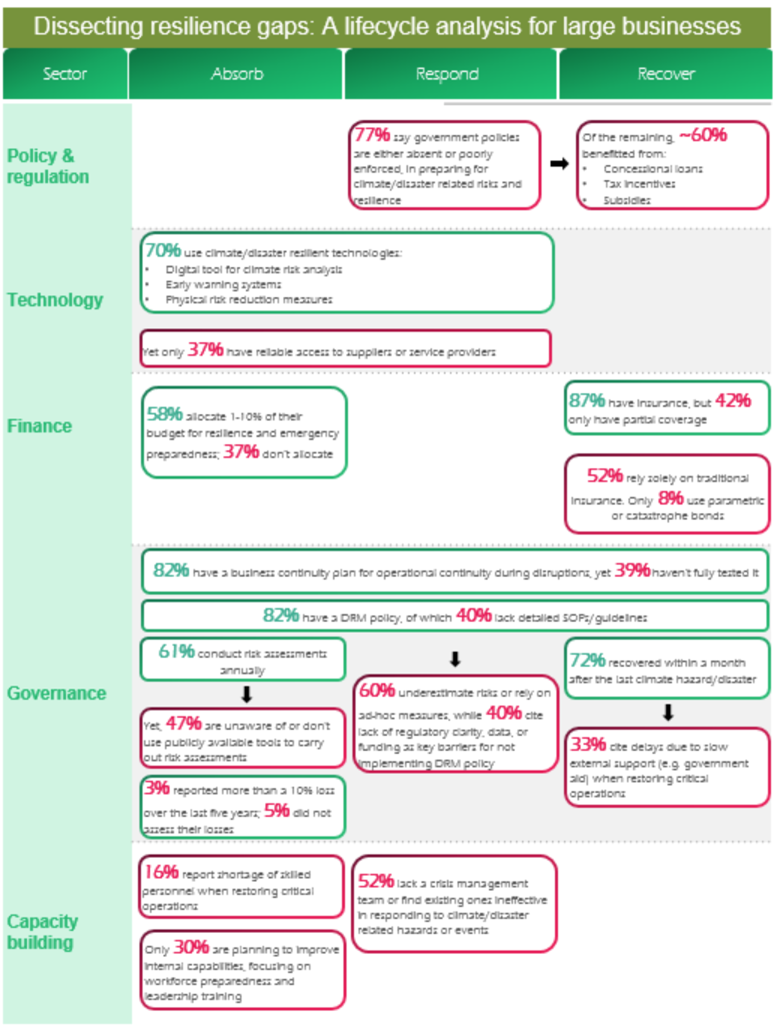
To make results actionable, the questionnaire was aligned to the three capacities of the resilience cycle: to absorb, respond to, and recover from disasters. The questionnaire was also mapped to five enabling levers: policy and regulations, technology, finance, governance, and capacity building. This structure yields a cross-sectional view of where resilience breaks down, and which levers move the needle. For example, Figure 1 offers a detailed perspective of resilience gaps for large businesses. |
|
|
|
|
|
Figure 1. Dissecting resilience gaps for large non-infrastructure businesses: insights from survey answers |
|
|
The survey yielded several key insights. Many large firms still assess hazards in isolation, missing the opportunity to leverage real-time, data-driven insights from national and global forecasting systems. Furthermore, coverage often focuses on site hazards. However, for many industries, value-chain risks, such as disrupted inputs and blocked logistics nodes, may exceed direct exposure in the form of damage to owned facilities. According to the survey, 85 percent of large firms do not consider supplier resilience during vendor selection, a striking weakness given the scale and complexity of their supply chains. An excellent example of a large firm recognizing this weakness and moving swiftly to build resilience comes from Toyota. After its operations were severely disrupted by the 2011 Tohoku earthquake, the company instituted policies for supplier diversification, such as standardizing critical components and geographically distributing manufacturing. It also implemented new risk management protocols, including holding strategic inventories and dual-sourcing critical parts. Seven years later, when floods in West Japan caused $10 billion in losses across Japanese industries, they had no material impact on Toyota. The company reached out to alternate suppliers for 80,000 vehicles, and its four affected factories were restored to operations within three days. Another large company excelling in disaster readiness is Walmart, which has extensive disaster preparedness training for employees in relation to hurricanes and floods and regularly conducts nationwide disaster simulation drills. The survey shows that governments need to take a more proactive role in supporting businesses in responding to disasters. Thirty-seven percent of infrastructure companies and 33 percent of large businesses reported delays in recovering from disasters because of low external support. Seventy-seven percent of medium-sized enterprises perceive government mechanisms as reactive and fragmented, particularly in emerging markets. The survey also points to a significant opportunity for private providers of resilience solutions, as many businesses struggle to find the right expertise, tools, and services to help them prepare for and respond to disasters. This gap represents a growing market opportunity and highlights the need for more accessible and practical resilience solutions. By contrast, some examples of government action show how acute losses can force policy innovation, leading to risk-sharing mechanisms that blend public and private resources. The 2017-18 wildfires in California pushed the Pacific Gas & Electric utility toward bankruptcy, with $30 billion in liabilities. In response, the California state government launched a $21 billion Wildfire Fund to cover future utility liabilities and stabilize the grid. Access to this fund was contingent on the utility investing $5 billion in safety upgrades and co-funding the initiative with ratepayers over 15 years. The scheme offered fast relief and incentivized long-term resilience. The survey shows that SMEs, unsurprisingly are especially vulnerable to disasters, mainly due to resource constraints and a lack of fallback systems. Given the limited financial capacity of SMEs, most of them treat resilience spending as discretionary, allocating marginal budgets or none at all. Only one in three medium-sized enterprises can recover within a month of a disaster, compared to more than 50 percent of large enterprises. But even large companies have not institutionalized disaster response procedures, with 60 percent relying on ad-hoc responses. Furthermore, 40 percent cited the lack of clarity in regulations, funding, or risk data as significant barriers to designing and implementing effective disaster response systems. (Figure 1). Finally, the survey shows that government agencies often focus on reliability, safety, and compliance—adopting proven technologies through structured procurement and long-term planning. In contrast, private firms tend to be more agile, leveraging emerging digital tools to manage risks and optimize performance. While public players prioritize stability, private entities often lead in piloting innovation. Aligning both approaches is key to scaling resilient, tech-enabled infrastructure systems. The first version of the Global Business Resilience Survey, then, demonstrates the importance of gathering information directly from businesses to understand their challenges and innovations in the areas of resilience and the specific needs and support they require from infrastructure service providers and the government. Building resilience requires more than isolated interventions—it demands a systemic approach that embeds adaptation across every stage of the business lifecycle, from strategy and planning to operations and end-of-life. For more details on the survey methodology and full results, please refer to the detailed working paper on this topic, published as part of the GIR 2025 series. |
|
|
By: Ashish Kulkarni, Partner & Director, Boston Consulting Group (BCG); Anirban Mukherjee, Managing Director & Senior Partner, BCG; Annika Zawadzki, Managing Director & Partner, BCG; Nikhil Bharadwaj, Principal, BCG; Pranjal Kapoor, Senior Manager – Travel Cities & Infrastructure Practise, BCG; Tania Banerjee, Associate Director, BCG; Vineet Vijayavargia Managing Director & Partner, BCG. |
|
|
This blog forms part of a series under the ambit of CDRI’s second Global Infrastructure Resilience Report (GIR 2025). The main report, executive summary, and the corresponding working paper associated with this workstream are also available on CDRI's official website, at: https://cdri.world/resilience-dividend/global-infrastructure-resiliencereport-second-edition/. |
|