
 |
The first blog in the series emphasized the role of private sector actions for disaster resilient infrastructure, while the core argument in the second blog was finance that transforms resilience from a theoretical concept into a bankable asset class. This third blog turns to a specific, underexplored source of domestic financing — India’s mandatory Corporate Social Responsibility (CSR) regime. Since learning from one country’s experience and sharing it with others is a key mandate of the Coalition for Disaster Resilient Infrastructure (CDRI), the blog also looks at replication mechanisms. |
|
Source: Shutter Stock |
|
|
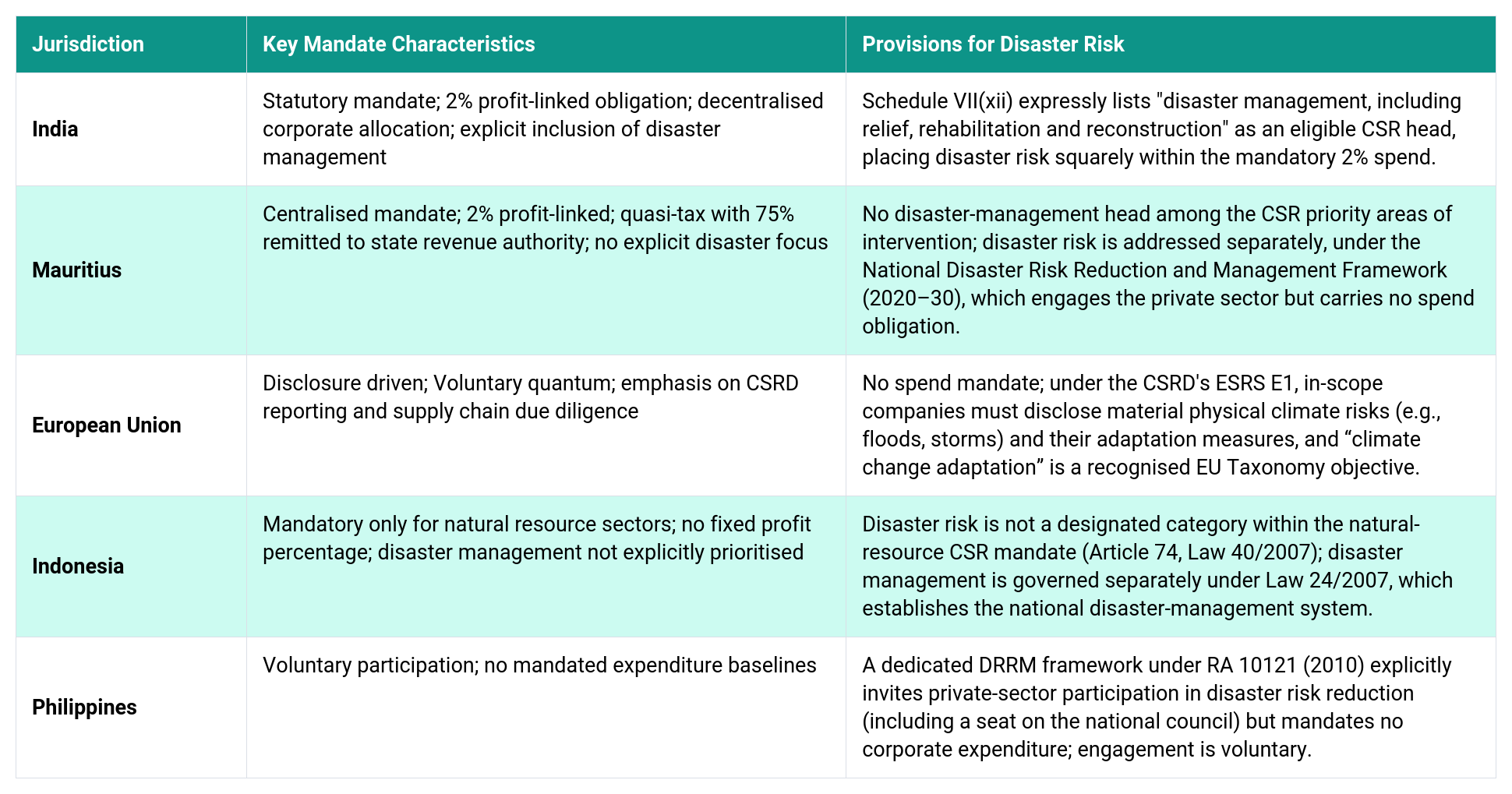
Section 135 and Schedule VII: A Statutory Mandate Section 135(2) of the Indian Companies Act, 2013 mandates qualifying companies to allocate at least 2 per cent of their average net profits of the past three years to activities listed in Schedule VII of the Act[i]. In FY 2020–21, more than 18,000 companies reported CSR expenditure exceeding USD 3.2 billion across over 38,000 projects, and annual flows now approximate Rs 25,000 crore (about USD 3 billion), one of the largest statutorily obligated pools of private social capital globally[ii]. Among the twelve categories of eligible spending, Schedule VII (xii) stands out for its direct relevance to climate and disaster risk: it covers “disaster management, including relief, rehabilitation, and reconstruction”, a statutory mandate to deploy private capital precisely where physical risk is greatest. This provision, however, calls for a distinction between three related but different ideas: disaster management, post-disaster recovery, and disaster resilience. The operative words of Schedule VII (xii), “relief, rehabilitation and reconstruction” lean towards response and recovery; disaster resilience of infrastructure, as an ex-ante objective, is not expressly named in the Indian statute, nor in most of the country frameworks compared below. What, then, is possible within the current regulatory framework? The Disaster Management Act, 2005 (Section 2(e)) defines “disaster management” as a continuous and integrated process that expressly includes prevention, mitigation, capacity building, and preparedness not merely response, relief, and reconstruction[iii]. The Ministry of Corporate Affairs has separately directed (General Circular No. 21/2014) that the entries in the said Schedule VII must be interpreted liberally so as to capture the essence of the subjects enumerated[iv]. Read together, CSR expenditure on strengthening infrastructure before a disaster strikes sits comfortably within the existing statutory scope: retrofitting schools and primary health centres that double as cyclone shelters, flood-proofing rural water and sanitation assets, community-level early-warning systems, and bio-shields that protect coastal infrastructure are all permissible today, without any amendment to the law. Rule 7(4) of the Companies (CSR Policy) Rules further permits capital assets created from CSR funds to vest in public authorities or beneficiary communities — the very ownership structures that community-scale resilient infrastructure requires. India’s Distinctive Position: A Comparative Perspective India’s Section 135 stands out as the only national framework that combines a universal, profit-linked CSR mandate with an explicit statutory head for disaster management investment, a significant, yet underutilised, policy asset at a time when many low- and middle-income countries and multilateral institutions are actively seeking replicable models for domestic private resource mobilisation in climate adaptation. As the comparative snapshot below shows, other regimes either encourage private participation without mandating spend (the Philippines), rely on disclosure rather than expenditure (the European Union), or mandate spend without an explicit disaster head (Mauritius — the closest parallel, with its centralised 2 per cent regime channelled through the state). |
|
|
|
|
|
Table 1: Comparative Analysis of CSR Frameworks and Disaster Risk Provisions. Sources:[v],[vi],[vii],[viii],[ix],[x],[xi] |
|
|
The Indian Climate Context: Why This Matters Now Beyond its comparative distinctiveness, India’s domestic record shows that this capital can already be put to work at scale. Reliance Industries has supported climate-resilient villages, large-scale water harvesting, and mangrove bio-shields[xii]. Tata Power has deployed over 200 microgrids[xiii]. ITC’s climate-smart agriculture programme covers 2.5 million acres[xiv]. NTPC has invested in rural solar microgrids and agricultural pump efficiency[xv]. HDFC Bank’s Parivartan initiative targets climate-vulnerable livelihoods at scale[xvi]. Yet the dominant pattern in disaster-linked CSR remains reactive: a substantial share is still deployed as post-event relief following cyclones, floods, or droughts, rather than as sustained pre-emptive investment in the resilient systems that already fall within the statutory scope of Schedule VII. The stakes are high. Germanwatch’s Climate Risk Index 2026 ranks India as the ninth most affected country over the 1995–2024 period, recording 430 extreme weather events and economic losses exceeding USD 170 billion[xvii], while the Notre Dame Global Adaptation Initiative (ND-GAIN) Index places India 111th globally on the combined dimensions of climate vulnerability and readiness[xviii]. Section 135 thus offers what public budgets and donor channels rarely combine: predictable annual capital flows, a mandatory legal structure, and explicit statutory coverage of disaster-related funding. Structured deployment of this capital toward DRI can also generate demonstration effects for replication in CDRI member countries such as Mauritius that already possess mandatory CSR architectures — and beyond, including Indonesia, the Philippines, and countries in Latin America. Structural Shifts Required Truly unlocking the dormant potential of Section 135 capital, however, requires deliberate structural shifts, beginning at board level: reframing disaster-related CSR from reactive philanthropy or compliance-driven expenditure toward strategic risk mitigation and resilience investment. Pre-emptive investments in resilient infrastructure generate returns several times higher than post-event relief by protecting supply chains, labour markets, and long-term asset values. This reframing is consistent with the statutory text of Schedule VII and aligns with rising expectations from shareholders, credit rating agencies, and regulators under SEBI’s BRSR framework. Beyond its domestic application, the same architecture can be positioned at forums such as the G20 and the Conference of the Parties (COP), which have already called for a greater private sector role in building resilience as a replicable model for emerging market and developing economy (EMDE) contexts. CDRI’s Catalytic Role Against this backdrop, CDRI is uniquely positioned to provide the institutional architecture that individual governments, corporate foundations, and multilateral lenders cannot assemble independently, serving as a bridge between currently fragmented corporate initiatives and regulatory frameworks. No investor-ready pipeline of bankable DRI projects exists at scale, either globally or in India and the predictability and annual scale of mandatory CSR flows can be deliberately deployed to seed and de-risk exactly such a pipeline. In practice, this means deploying CSR where it is regulatorily strongest and commercially weakest: at the earliest stage of the project cycle. Because CSR funds are grant-based and do not seek financial returns, they are ideally suited to cover the early-stage costs that currently prevent resilient infrastructure projects from becoming bankable. These include hazard and vulnerability assessments, pre-feasibility studies, detailed project reports, pilot and demonstration assets, and capacity building of local implementing institutions. The existing rules already provide the machinery: companies may collaborate and pool CSR resources on common projects while reporting separately; commitments can be structured as multi-year “ongoing projects” with unspent amounts ring-fenced rather than lapsing; and the mandatory impact assessments required of larger projects generate the performance evidence that later-stage public and blended finance requires. Deployed this way, CSR does not substitute for infrastructure finance. It becomes the first, de-risking layer of a pipeline that mainstream capital can subsequently take to scale. CDRI can pilot this structured CSR mobilisation approach in India and support its replication in member countries with analogous regulatory frameworks. The longer-term objective is to demonstrate that well-structured, institutionally anchored domestic corporate capital can become one of the most potent and predictable sources of financing for disaster resilience, to help transform India’s CSR architecture into a replicable model for domestic private capital mobilisation in climate adaptation. |
|
|
[i] Ministry of Corporate Affairs. (2013). The Companies Act, 2013, Section 135 – Corporate social responsibility. India Code. https://www.indiacode.nic.in/show-data?actid=AC_CEN_22_29_00008_201318_1517807327856§ionId=1326§ionno=135&orderno=139 [ii] Ministry of Corporate Affairs, Government of India. (n.d.). CSR expenditure summary. National CSR Portal. https://www.csr.gov.in/content/csr/global/master/home/home.html [iii] Ministry of Home Affairs. (2005). The Disaster Management Act, 2005, Section 2(e) – Definitions. India Code. https://www.indiacode.nic.in/handle/123456789/2045 [iv] Ministry of Corporate Affairs, Government of India. (2014). General Circular No. 21/2014: Clarifications with regard to provisions of corporate social responsibility under Section 135 of the Companies Act, 2013. IBC Law. https://ibclaw.in/clarifications-with-regard-to-provisions-of-corporate-social-responsibility-under-section-135-of-the-companies-act-2013-mca-general-circular-no-21-2014-dated-18-06-2014/ [v] Ministry of Corporate Affairs. (2013). The Companies Act, 2013, Schedule VII – Activities eligible for CSR expenditure. India Code. https://upload.indiacode.nic.in/schedulefile?aid=AC_CEN_22_29_00008_201318_1517807327856&rid=79 [vi] Mauritius Revenue Authority. (n.d.). CSR guide. https://www.mra.mu/download/CSRGuide.pdf [vii] European Commission. (2023). Corporate sustainability reporting. https://finance.ec.europa.eu/financial-markets/company-reporting-and-auditing/company-reporting/corporate-sustainability-reporting_en [viii] European Commission. (2023). Corporate sustainability reporting. https://finance.ec.europa.eu/financial-markets/company-reporting-and-auditing/company-reporting/corporate-sustainability-reporting_en [ix] Green Finance Platform. (2012). Corporate responsibility regulation: Indonesia Regulation No. 47/2012. https://www.greenfinanceplatform.org/policies-and-regulations/corporate-responsibility-regulation-indonesia-regulation-no-472012 [x] Senate of the Philippines. (2010). Republic Act No. 10121 – Philippine Disaster Risk Reduction and Management Act of 2010 [Senate bill data]. https://legacy.senate.gov.ph/lisdata/3284329699!.pdf [xi] Official Gazette of the Republic of the Philippines. (2010, May 27). Republic Act No. 10121: An act strengthening the Philippine disaster risk reduction and management system. https://www.officialgazette.gov.ph/2010/05/27/republic-act-no-10121/ [xii] Reliance Industries Limited. (2025). Online annual report 2024–25. https://www.ril.com/investors/financial-reporting/online-annual-report [xiii] Tata Power Company Limited. (2025). Annual report 2024–25. https://www.tatapower.com/company-financials/annual-reports/106annualreport-2024-25.pdf [xiv] ITC Limited. (2025). Reports and accounts 2024–25. https://itcportal.com/investors/itc-reports-and-accounts.html [xv] NTPC Limited. (2025). Annual report 2024–25. https://ntpc.co.in/investors/annual-reports/2024-25 [xvi] HDFC Bank Limited. (2025). Annual report 2024–25. https://www.hdfc.bank.in/content/dam/hdfcbankpws/in/en/pdf/annual-reports/2024-25/HDFC_Bank_Annual_Report_2024_25-310202.pdf [xvii] Eckstein, D., Künzel, V., & Schäfer, L. (2025). Global climate risk index 2026: Who suffers most from extreme weather events? Weather-related loss events in 2024 and 2025 (long-term index: 1995–2024). Germanwatch. https://www.germanwatch.org/en/93310 [xviii] Notre Dame Global Adaptation Initiative. (2024). ND-GAIN country index: India. University of Notre Dame. https://gain-new.crc.nd.edu/country/india |
|
|
By: Avinash Venkata Adavikolanu, Specialist-Knowledge Management, CDRI |
|
|
This blog is the third in the series on Mobilizing Private Sector Actions for Disaster Resilient Infrastructure (DRI). |
|
|
|
|