
 |
At its core, resilience is an intensely practical matter, requiring coordinated strategies and implementation, in challenging real-world and time-sensitive contexts, from scores of stakeholders across the public and private sectors. Yet, despite the emergence of a consensus on the importance of building resilience, the evolution of a theoretical framework for resilience, and the dissemination of standardized strategies and protocols for resilient infrastructure design and disaster response, the landscape of infrastructure resilience across the globe remains very uneven. Hence, the Global Infrastructure Resilience Report 2025 (GIR25) seeks to establish what resilience looks like to those working on the ground today. |
|
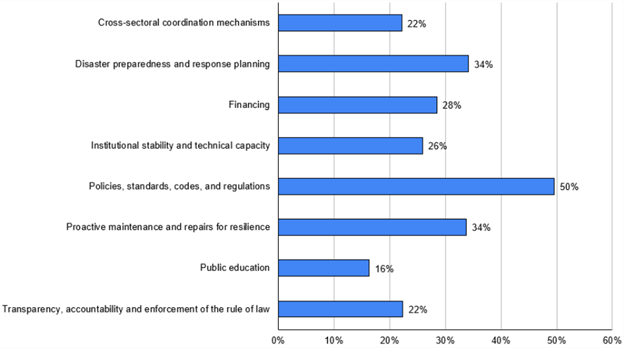
The Global Infrastructure Resilience Survey (GIRS) for infrastructure experts and professionals – including engineers, planners, policymakers, and private sector actors – is the largest of its kind, capturing insights from over 3,000 professionals across 100+ countries in six languages. A global online questionnaire generated broad quantitative data, while in-depth interviews with 80+ professionals from over 40 countries added qualitative depth and context. The survey invited perspectives on six core themes: governance and institution, finance, nature-based solutions, advanced technologies, and monitoring systems. The results provide a unique global picture of strengths, gaps, and opportunities for building resilience from those working in the field. To take one striking insight from the survey, the global outlook on regulations, codes, and standards reveals a striking contrast between widespread existence and limited adequacy. Between 53 and 65 percent of survey respondents reported that regulations exist but are outdated, incomplete, or misaligned with current hazard realities. Importantly, this was a view shared by both government and private sector stakeholders. Enforcement emerges as an even greater challenge, resulting in regulations that exist largely on paper. Unsurprisingly, when survey respondents were asked what the priorities should be for governments to enhance infrastructure resilience, 50 per cent said that strengthening policies and standards are at the core of improving resilience. (Figure 1) |
|
|
|
|
|
Figure 1. Respondents' views of the top priorities for governments |
|
|
Only 15% of respondents believe that the public sector has adequate capacity for resilient infrastructure. Only 29% say that private sector capacity is adequate. |
|
|
|
|
|
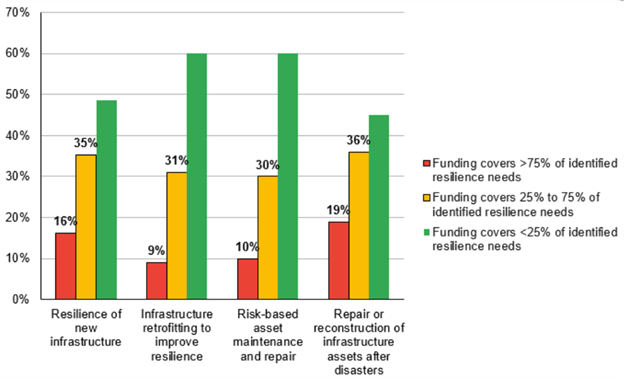
Figure 2. Adequacy of government funding |
|
|
Funding for preventive and resilience-focused measures is severely constrained worldwide. In contrast, post-disaster repair and reconstruction receive comparatively higher, though still limited, funding. |
|
|
A consistent finding across regions and country income levels is that disaster response and recovery generate stronger coordination than mitigation or preparedness, revealing a fundamental challenge: visible crises mobilize institutional collaboration more effectively than proactive risk reduction. Expert interviews consistently confirmed this pattern. Institutional capacity and human resources for infrastructure resilience remain highly uneven worldwide. Institutional capacity was rated as adequate by only around 15 percent of respondents; close to 40 percent described it as limited. Limited capacity cascades across the system, weakening regulatory enforcement, data infrastructure, and risk assessments, fostering reactive rather than proactive planning. Across several areas – including capacity, retrofitting, inclusion of future climate scenarios in risk assessments, and adoption of advanced technologies and nature-based solutions (NbS) for resilience – only 12 to 15 percent of respondents reported comprehensive implementation. This ‘implementation ceiling’ reflects structural limits under current institutional arrangements. This also suggests that engineering education must simultaneously be reformed to embed resilience thinking from the outset. Most infrastructure continues to rely on outdated methods. Knowledge of advanced technologies and NbS is increasing, yet they largely remain at the pilot stage or confined to flagship or donor-driven projects and are not being used to their full potential. Experts highlight stark disparities in the adoption of digital and smart technologies for infrastructure resilience across country income levels, showing that these are not being used to anywhere like their full potential. Other insights from the survey show contrasts between the quality of different aspects of resilience disaggregated by country income levels or by regions. Identifying such patterns helps generate opportunities for cross-regional learning and the need for context-specific strategies. For example, regional and income-level variations show that resilience does not follow linear development trajectories across countries, nor is it a function of mere resource availability. Low-income countries with donor-supported initiatives may achieve higher coverage of pilot programmes, while some middle-income regions demonstrate human resource strengths despite broader institutional constraints. Differences across country income levels also reveal distinct stages of infrastructure lifecycle management: wealthier nations face the challenge of maintaining ageing assets, while developing countries confront weak governance structures that undermine resilience efforts. Significantly, even in high-income countries, integration of resilience into codes and standards is not as extensive as it should, and engineers often resist non-traditional approaches. Last, the East Asia and Pacific region reported the strongest results on many criteria, such as public sector capacity and the use of risk assessments. This likely reflects lessons learned from repeated disaster exposure. The weaker performance of some high-income regions suggests that limited disaster experience can foster complacency in system development. Overall, the findings indicate some of the practical and institutional challenges of translating blueprints of resilience into practice and offer decision makers a clear set of evidence-based priorities. Infrastructure resilience is constrained less by technical solutions than by governance, institutional capacity, and systemic integration. Addressing these challenges will require sustained political commitment, proactive engagement across government, and active private sector participation to shift focus from short-term visibility towards long-term adaptation and resilience. |
|
|
By: Savina Carluccio (Executive Director, ICSI); Fruzsina Csala (Project Coordinator, ICSI); George Karagiannis (Risk and Resilience Director, ICSI); Katie Momber (Senior Programme Manager) |
|
|
This blog forms part of a series under the ambit of CDRI’s second Global Infrastructure Resilience Report (GIR 2025). The main report, executive summary, and the corresponding working paper associated with this workstream are also available on CDRI's official website, at: https://cdri.world/resilience-dividend/global-infrastructure-resiliencereport-second-edition/. |
|