
 |
The word “infrastructure” is commonly associated with built assets and systems. Yet the resilience of the built environment can be greatly enhanced when it works with nature as an ally, not against it. The capital-intensive grey or “hard” solutions that are often offered as protective responses for infrastructure can and should incorporate “green” and “blue” solutions that channel the ecological functions of forests, ecosystems, and oceans to deliver resilience. In fact, when executed well, nature-based solutions (NbS) are not only quite effective in building resilience for infrastructure systems. They are also unique in their capacity to deliver environmental benefits (biodiversity, water and air quality), social benefits (health, jobs, recreation, community engagement, civic ownership), and economic benefits (lower maintenance, increased tourism, stabilization of business operations during and after climate hazards). |
|
Bamboo fence in Thailand |
|
|
The GIR 2025 report collates numerous examples of such projects from around the world, such as:
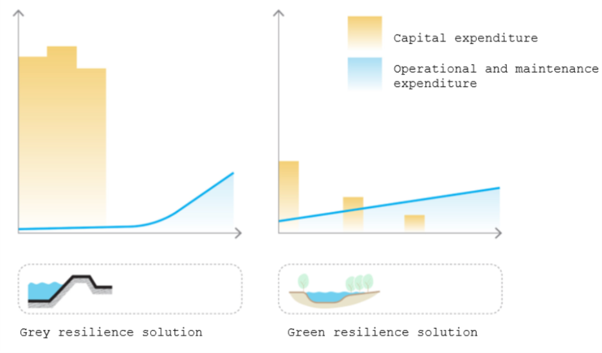
Most of the discussion on NbS and resilient infrastructure focuses on the capacity of these solutions to help absorb shocks from disasters, such as by acting as flood and wind buffers or reducing flood peaks. But, to draw on the “three capacities framework” used through GIR25 to define a broad-based resilience, nature-based solutions integrate very well with the capacity to respond and recover, too. Locally governed, community-led NbS like flood channels or small wetlands enable communities to keep critical services functional during disasters without waiting for central directives. Hydrological and soil restoration regenerate soils devastated by disasters. Ecosystem restoration regenerates livelihoods based on fish, crops and forest products. Nature-based solutions have attracted considerable interest in policy and research, yet their application at scale remains limited and often fragmented. Why so? As Figure 1 shows, grey infrastructure typically involves higher upfront capital costs, driven by materials, engineering, and construction complexity. These costs are relatively predictable, although they often exclude long-term environmental externalities. In contrast, NbS tend to have lower initial investment costs, especially when leveraging existing ecosystems or community-based implementation, but also generally require an initial lead time to build up full performance capacities, whereas grey components typically deliver immediate resilience benefits. |
|
|
|
|
|
Figure 1. Illustrative cost timelines for green and grey infrastructure solutions Source: World Bank (2023), adapted from Wishart et al., (2021). |
|
|
Nature-based solutions are not a niche alternative to conventional works, but a core part of contemporary infrastructure resilience strategies. |
|
|
This suggests that even if NbS by themselves cannot replace grey solutions, grey solutions can be improved considerably as hybrid solutions incorporating NbS. Recent Sustainable Asset Valuation assessments (SAVi) show that NbS typically cost about 50 percent less upfront than built alternatives, while offering equal or greater benefits. Yet there are some caveats and challenges related to NbS that need to understood. NbS sometimes requires more land and engagement with farmers and communities for maintenance and long-term resilience performance of these solutions. Infrastructure agencies may hesitate to take on ecological management responsibilities. |
|
|
Nature-based solutions for resilient infrastructure must move from pilots to use at scale. They need to be embedded in master plans, infrastructure strategies, and PPP agreements. |
|
|
The deployment of NbS as more than niche solutions, then, requires a change of mindset from infrastructure agencies, governments and policymakers. The structural integration of NbS as a core component of resilience action requires five strategic levers: Institutional: Scaling-up NbS use requires integrating them into institutional goals, project pipelines, and technical guidelines. Procurement frameworks for infrastructure agencies should consider ecological criteria alongside engineering standards, while also stipulating budgets for ecological maintenance and monitoring. Policy and governance: Policy and governance frameworks set the ‘rules of the game’ for infrastructure agencies. Embedding NbS into master plans, sectoral strategies, and PPP agreements ensures they are considered from the outset of infrastructure planning, not as optional add-ons. Equally important are governance mechanisms that institutionalize stakeholder engagement. Formalized processes such as statutory consultation requirements, participatory design protocols, or co-management agreements can ensure that citizens, local communities, and private landholders are part of decision-making. Technical: Standardized design guidelines, modelling tools, and performance metrics allow infrastructure agencies to plan, build, and maintain NbS with confidence. Monitoring and adaptive management can close the feedback loop between design and performance. Financial: Integrated cost-benefit tools that account for both direct and indirect benefits (such as avoided flood damage, carbon sequestration, and social well-being) allow decision makers to compare NbS with conventional alternatives on a holistic basis. Instruments such as blended finance, PPPs, and performance-based contracts can align incentives for both public and private actors. By linking remuneration to ecological outcomes and resilience performance (such as with Vietnam’s Payments for Forest Environmental Services programme), it is possible to compensate farmers, fishermen, or communities for their efforts to ensure the resilience services of NbS. Capacity: To implement NbS at scale, infrastructure agencies need to develop technical expertise in ecology and related subjects alongside traditional engineering. Capacity development also extends to management staff and decision makers, enabling informed choices on integration and trade-offs. The GIR 2025 sets out a practical route for such a shift by providing a Readiness Checklist for institutionalizing NbS. By applying the Checklist, aligning incentives, and treating ecosystems as operational infrastructure, governments and their partners can mainstream NbS as reliable, scalable components of resilient systems. |
|
|
By: Floris Boogaard, Senior Consultant, Deltares; Hsoc Mathai, Advisor, Deltares; Lakshman Srikanth, Senior Advisor, Disaster Risk Management |
|
|
This blog forms part of a series under the ambit of CDRI’s second Global Infrastructure Resilience Report (GIR 2025). The main report, executive summary, and the corresponding working paper associated with this workstream are also available on CDRI's official website, at: https://cdri.world/resilience-dividend/global-infrastructure-resiliencereport-second-edition/. |
|