
 |
Infrastructure sectors in Small Island Developing States (SIDS) are highly exposed to tropical storms, sea level rise, and flooding. Because of the small land size of these states, a major disaster such as a cyclone can often devastate the entire economy and impact most or all of the population. This vulnerability is exacerbated by reliance on single road networks, centralized power generation systems, and limited port infrastructure. Further, most settlements in SIDS and many key infrastructure assets are typically located in vulnerable low-elevation coastal zones. As a group, they are, proportional to the size of their economies, the most disaster-prone countries. On average, SIDS lose about 2.1 percent of their GDP annually due to disasters.
|
|
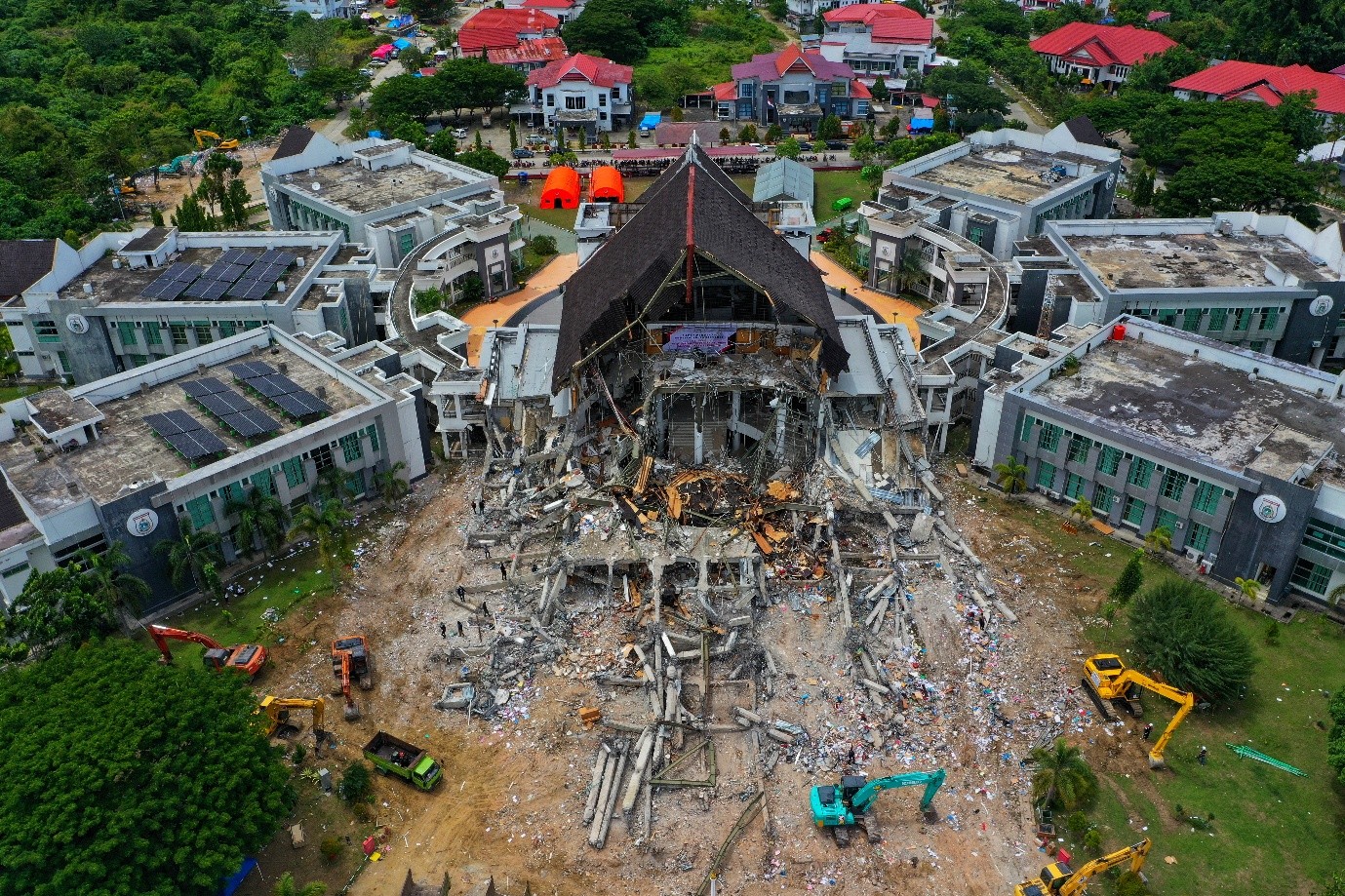
Damage from the Mamuju earthquake (Source: Shutterstock) |
|
|
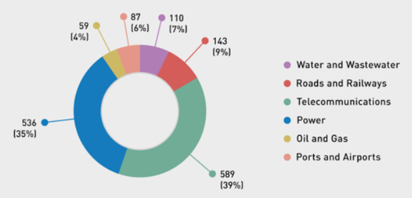
CDRI’s Global Infrastructure Risk Model and Resilience Index (GIRI) is the first publicly available and fully probabilistic risk model to estimate risk for infrastructure assets regarding most major geological and climate-related hazards. The GIRI model has been used for the first time to understand the risks that SIDS infrastructure faces. These projections are presented in detail in the GIR 2025 report and show that the average annual loss (AAL) for infrastructure sectors in SIDS is $1.5 billion (rising to US$ 3.8 billion when including buildings). This is a financial indicator that is linked to the contingent liabilities countries have due to insufficient resilience in infrastructure, or the level of insurance that they may need to cover damages. Cyclones are the most damaging hazard for SIDS, accounting for $3.27 billion or 62 percent of the total AAL. Floods contribute $1.15 billion or 22 percent, while earthquakes account for $678 million or 13 percent. Among infrastructure sectors, telecommunications bears the highest AAL at $589 million, followed closely by the power sector at $536 million (Figure 1). These are useful indicators that can enable Ministries of Finance and other decision makers to establish funding priorities and develop hazard- and sector-specific resilience measures. |
|
|
|
|
|
Figure 1. Average annual loss of infrastructure sectors for SIDS (in million US$) (Source: CDRI) |
|
|
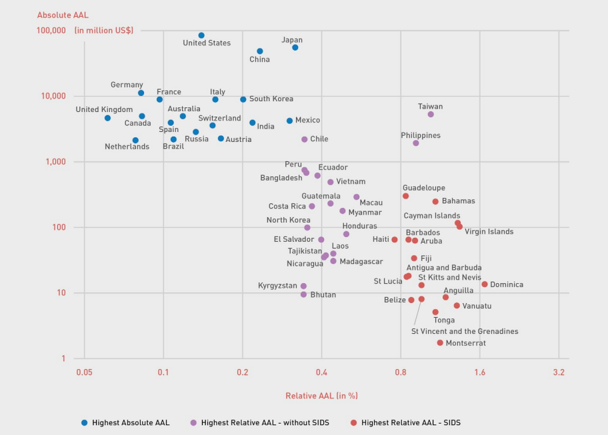
Making infrastructure assets in SIDS more resilient to disasters will require investments that are unlikely to be considered large or significant on a global scale, but that will make a critical difference to SIDS’ social and economic development. |
|
|
|
|
|
Figure 2. Absolute and relative AAL for infrastructure sectors in selected countries (Source: CDRI) |
|
|
Infrastructure for Resilient Island States (IRIS) is CDRI’s flagship programme offering financial and technical assistance, capacity building, and partnership support to all 57 SIDS. |
|
|
What this means is that making infrastructure assets in SIDS more resilient to disasters will require investments that are unlikely to be considered large or significant on a global scale, but that will make a critical difference to SIDS’ sustainable social and economic development. CDRI convened working groups of expects to issue a Call to Action for SIDS with practical recommendations:
CDRI is also supporting action on the ground. The Infrastructure for Resilient Island States (IRIS) is CDRI’s flagship programme offering financial and technical assistance, capacity building, and partnership support to all 57 SIDS. The initiative is funded by Australia, India, the European Union, and the United Kingdom through donations totalling $40 million. Currently, a total of 24 projects across 25 SIDS, including multi-country and regional projects, are being funded by the Programme. |
|
|
By: Ede Ijjasz-Vásquez, Coordinating Lead Author – Second Global Infrastructure Resilience Report, CDRI |
|
|
This blog forms part of a series under the ambit of CDRI’s second Global Infrastructure Resilience Report (GIR 2025). The main report, executive summary, and the corresponding working paper associated with this workstream are also available on CDRI's official website, at: https://cdri.world/resilience-dividend/global-infrastructure-resiliencereport-second-edition/. |
|