






 |
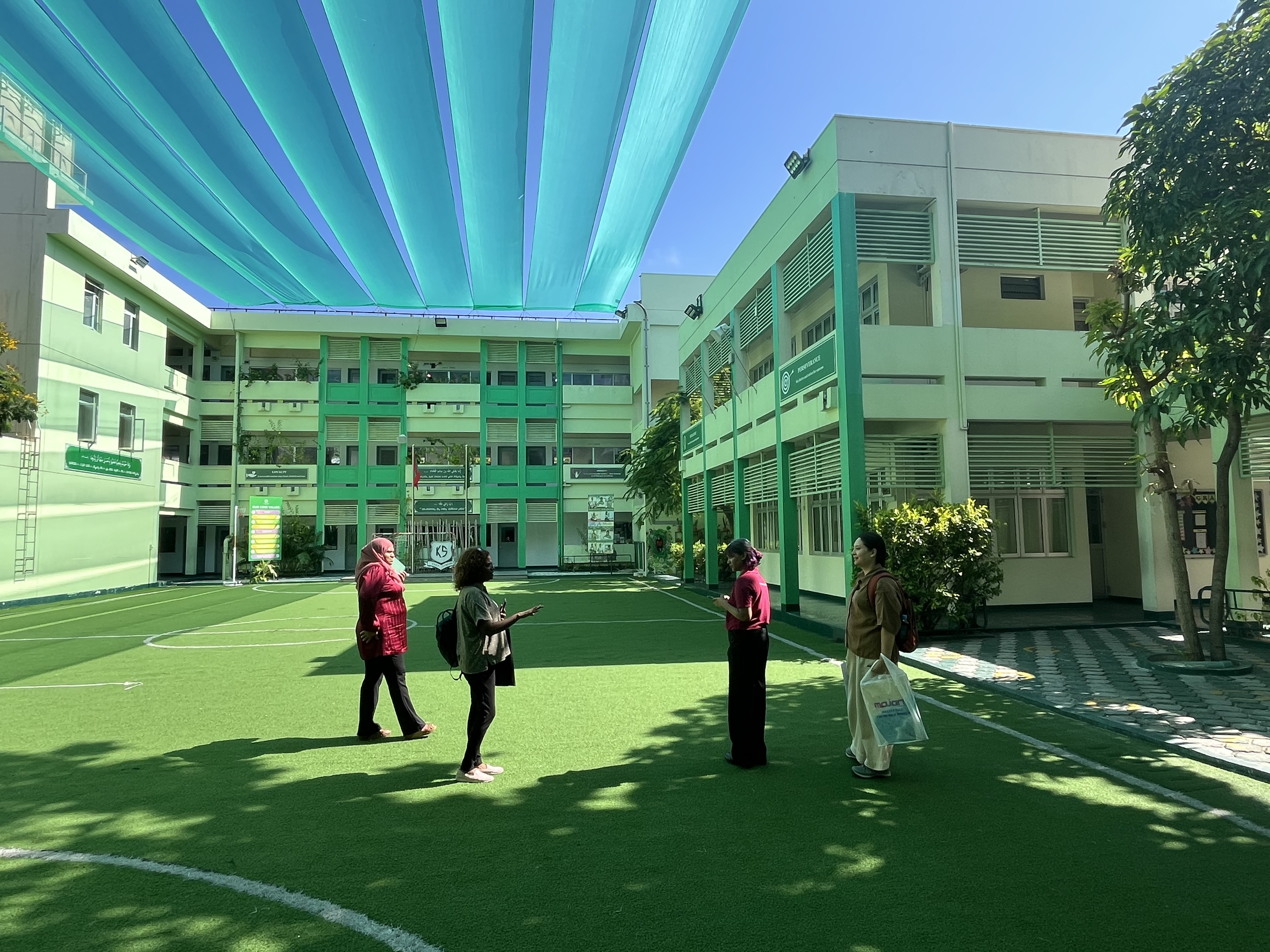
Children in the Maldives are growing up on the front lines of climate change. As a low-lying Indian Ocean atoll nation, the country is highly vulnerable to extreme heat, flooding, sea level rise and strong windstorms. A recent survey of 16 schools across the country found that flooding is already affecting daily education. More than 80% of surveyed schools experienced flooding with half indicating that flooding occurs whenever it rains, frequently linked to inadequate site drainage and poor building design. The Burden of Extreme Heat Extreme heat has also been affecting students and teachers. Almost 90% of schools surveyed reported having classrooms that are uncomfortably hot. |
|
Male Kalaafaanu School Building Assessment (Build Change) |
|
|
During focus group discussions, students said “Our classrooms are hot, it becomes unbearable in the afternoon” adding, “We experience headaches due to heat”. Teachers commented that “The classrooms don’t have enough fans and get very hot, particularly in the hot seasons. It affects the children’s ability to study” Children are particularly susceptible to negative impacts from heat stress. A 2025 meta-analysis reviewed data from nearly 14.5 million students across 61 countries found that long-term heat exposure impaired students’ cumulative learning, with complex tasks (e.g., mathematics) more affected than simpler ones (e.g., reading). Another meta-analysis found that student performance on psychological tests and school tasks can be expected to increase on average by 20% if classroom temperatures are lowered from 30 °C to 20 °C and that the temperature for optimal performance is lower than 22 °C. Evidence of the adverse effects of heat stress on children and learning outcomes: Children are particularly susceptible to negative impacts from heat stress. A 2025 meta analysis reviewed data from nearly 14.5 million students across 61 countries found that long-term heat exposure impaired students’ cumulative learning, with complex tasks (e.g., mathematics) more affected than simpler ones (e.g., reading). Another meta analysis found that student performance on psychological tests and school tasks can be expected to increase on average by 20% if classroom temperatures are lowered from 30 °C to 20 °C and that the temperature for optimal performance is lower than 22 °C. Design for Inclusion Resilience also means inclusion. Around 7% of students in the Maldives have Special Education Needs (SEN), a large majority of whom have developmental or learning disabilities. National policy gives every child the right to education without discrimination. However, this policy vision is not yet fully reflected in school infrastructure. Only one surveyed school was fully accessible for students with physical disabilities, while one third were not accessible at all. SEN teachers highlighted the need for classrooms located away from crowded and noisy areas with space for one-to-one work, storage for sensory equipment, calm finishes, nearby and accessible toilets. Girls also raised privacy and safety concerns. Some said they go home when they have their period because of inadequate menstrual hygiene facilities. Others remarked they do not feel safe because ventilation openings have clear sight lines into the toilets, adding that “The toilet area is very creepy and dark”. From Policy to Practice: The New National Standard Addressing these vulnerabilities requires navigating complex realities shared by many Small Island Developing States (SIDS). Maldivian education spans nearly 200 islands with high urban migration rates, tight institutional budgets, and limited local engineering capacity. To bridge this gap, the Maldives Ministry of Education is developing a national guideline for the design, construction and maintenance of schools. With funding from the Coalition for Disaster Resilient Infrastructure’s (CDRI) Infrastructure for Resilient Island States (IRIS) Programme and technical assistance from Build Change and Riyan Pvt. Ltd, the guideline will be critical in translating strong national policy into practical design requirements for resilient and inclusive schools. This will include passive cooling measures, flood-resilient drainage systems, inclusive and accessible design for students with SEN, and secure sanitation facilities. The guideline adopts a holistic definition of resilience: increased resistance to climate and natural hazards; affordability; suitability for the local culture and environment; adaptability to future demographic and climatic shifts; and the creation of schools that are inclusive, healthy and secure. Completion is anticipated in 2027 following cross-governmental review and a construction pilot. Ultimately, the guideline will be a practical tool for implementation of national policy and can serve as a blueprint for resilient school design across SIDS. By establishing a consistent minimum standard for new school infrastructure, it will reduce variation between projects and locations, supporting more equitable infrastructure delivery – ensuring that schools provide a common baseline of safety, accessibility, health and climate resilience for all children and school’ communities. |
|
|
By: Ariana Karamallis, Global Advocacy & Development Manager at Build Change; Louise Foulkes, Caribbean Director & Engineering Program Manager at Build Change |
|
|
Build Change extends its gratitude to the Governments of India, Australia, and the United Kingdom, and to the European Union, for their financial support through the Coalition for Disaster Resilient Infrastructure's Infrastructure Resilience Accelerator Fund (IRAF). |
|
