




 August 27, 2026, 3:30 pm
 https://zoom.us/webinar/register/WN_EmiTyRqlSoKblMV0uQzCxw
 5 Enrolled
Register Here: https://zoom.us/webinar/register/WN_EmiTyRqlSoKblMV0uQzCxw
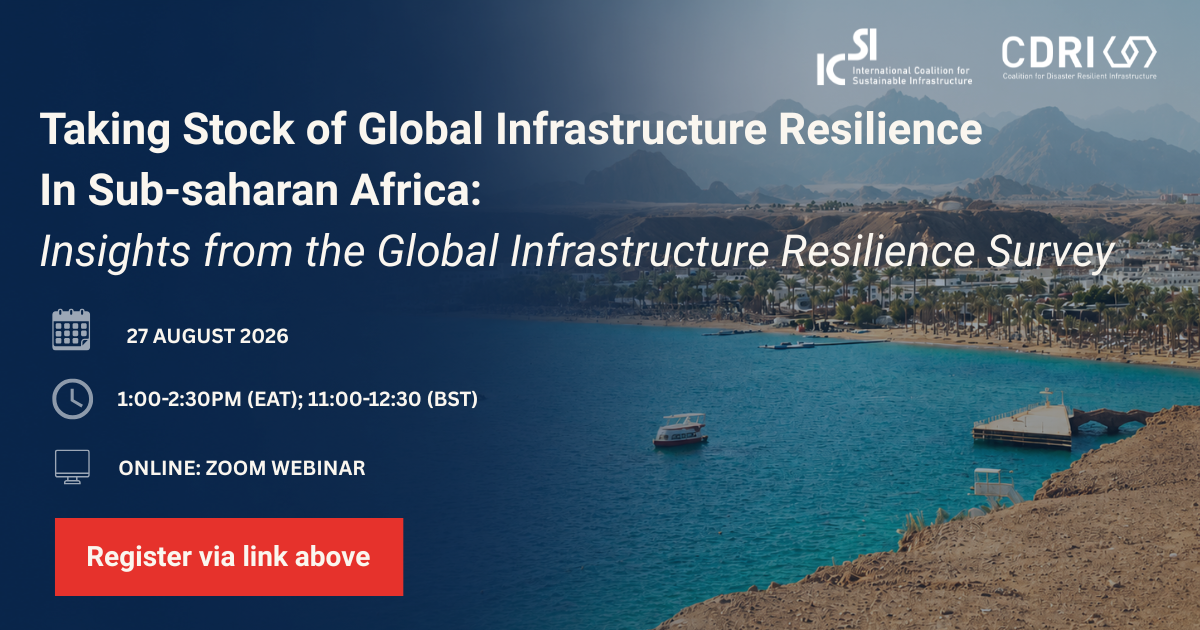
Undertaken in 2025, the Global Infrastructure Resilience Survey (GIRS) represents the largest global stocktake of infrastructure resilience to date, capturing the perspectives of over 3,000 professionals across more than 100 countries. The survey provides an unprecedented, practice-based view of the enabling conditions, systemic barriers, and emerging opportunities for scaling resilience across infrastructure planning, delivery, and management.
Following the launch of the GIRS Working Paper on World Engineering Day in March - which synthesises global findings alongside regional and income-level comparisons - ICSI and CDRI will convene a series of regional webinars throughout 2026.
The Sub-Saharan Africa webinar will explore how global findings from the GIRS apply to the region.
In Sub-Saharan Africa, institutional capacity remains constrained despite emerging frameworks and growing policy attention to resilience. Reliance on external expertise limits long-term
sustainability, as skills are not always retained locally. Reliance on external expertise limits long-term sustainability, as skills are not always retained locally. Investing in local workforce development and capacity-building presents a key opportunity to build more durable and self-sustaining resilience systems.
This capacity gap also shapes the region's uptake of nature-based solutions. While pilot projects are growing across the region, standards largely fail to reference NbS, integration with conventional infrastructure remains inconsistent, and in-house capacity to plan, implement, and maintain these solutions remains limited within government institutions. Scaling NbS from pilot projects to mainstream practice will require the same investment in local skills and institutional capacity needed across the wider resilience agenda.
The webinar will highlight how these challenges translate into practical opportunities for progress. Bringing together policymakers, practitioners, and industry leaders, it will focus on actionable solutions to strengthen capacity, improve coordination, and scale resilient infrastructure across the region.
